GEO: Why Whoever Starts Now Can Claim Space in AI Answers
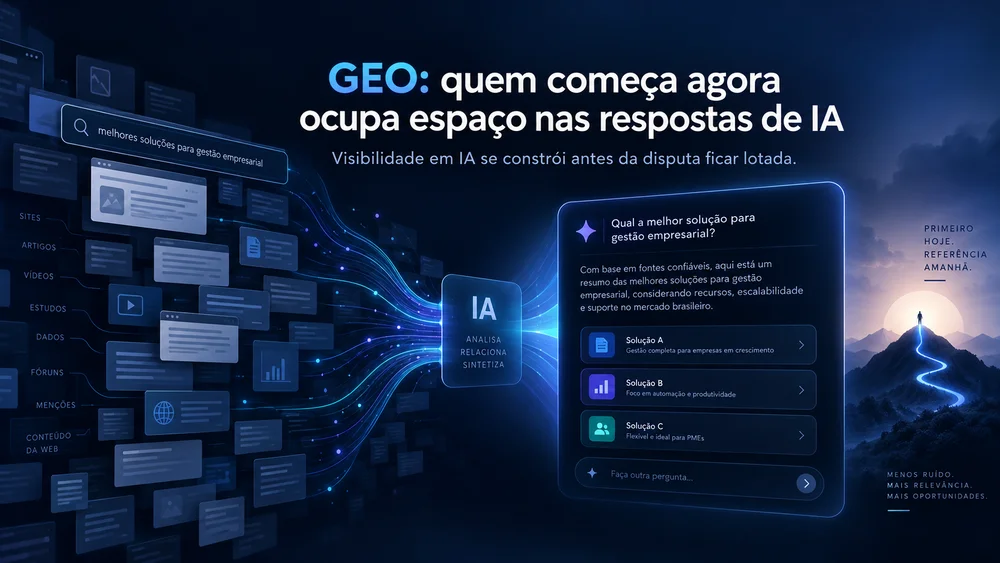
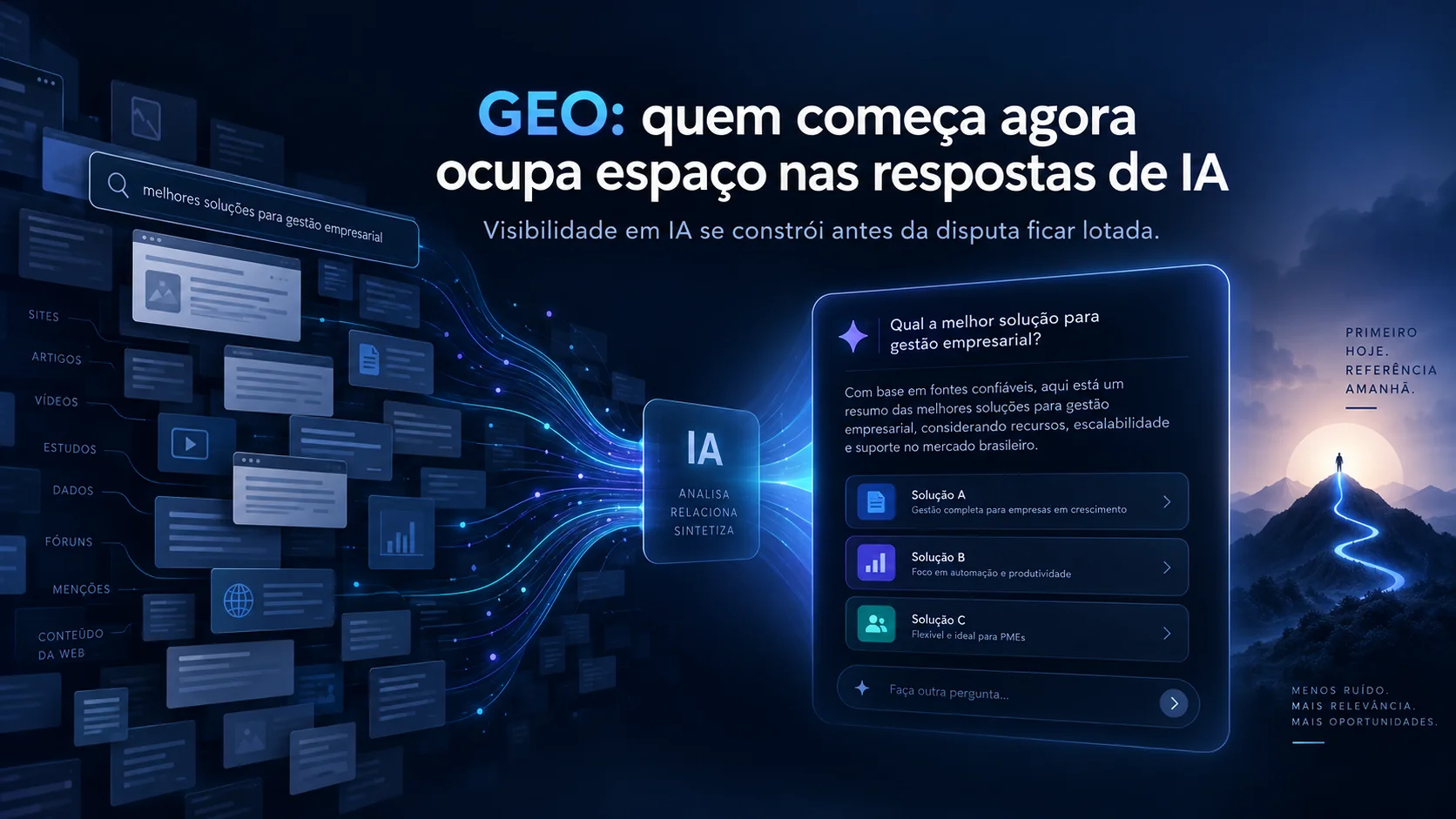
The fight for visibility is no longer happening only on the results page. Brands also need to be found, understood and considered when ChatGPT, Google and other AI experiences build an answer
There's an important difference between how a potential customer searched a few years ago and how they might search today. Before, the journey started with a keyword, a results page and several links opened for comparison. Now, part of it can start with a full question — "which company handles this problem?", "which vendors should I compare?" — answered in a synthesized way by an AI before the user ever visits any company's site.
That's exactly where GEO — Generative Engine Optimization — becomes important. The opportunity in starting early isn't discovering a "hack" to control LLMs. It's building, ahead of most of the market, the technical, editorial and authority assets that make a brand easier to find, understand and reference.
Direct Answer
Starting a GEO strategy now can create an advantage because presence in AI answers depends on assets that take time to mature: a crawlable site, consistent brand identity, genuinely useful content, pages that answer specific questions, external references and a measurement track record. This doesn't guarantee an AI will cite your company. It means that when generative systems search, retrieve and select information to answer the user, your brand will be better positioned to enter the set of sources and entities considered.
Search Behavior Changed Before Many Companies Noticed
The growth of AI usage in Brazil helps size this shift. In August 2026, OpenAI reported that Brazil was among ChatGPT's three largest markets by weekly active users and that Brazilians were sending about 215 million messages a day to the platform. In November 2025, OpenAI itself had reported approximately 140 million daily messages in the country.
The point isn't to claim all those messages are commercial searches — they aren't. What the data shows is something else: talking to an AI is already part of the digital behavior of millions of Brazilians. And in certain journeys, that changes the shape of discovery.
| Traditional search | Generative experience |
|---|---|
| User types keywords | User describes a need in natural language |
| Receives a list of pages | May receive a synthesized answer |
| Opens links and compares sources | Comparison can begin inside the answer itself |
| Visibility is perceived mainly through ranking position | Visibility can also happen through mention, citation or link |
| Traditional SEO metrics dominate | New exposure and reference metrics start to matter |
This doesn't mean Google or links have disappeared. It means a new layer has been added to the discovery journey.
The Data Showing the Size of the B2B Opportunity
One of the most interesting studies on this gap was published by the 2X AI Innovation Lab in April 2026. The AI Visibility Index analyzed 70 B2B companies and assessed how these brands showed up in queries made throughout the buying journey.
According to the survey, only 4.3% of the companies analyzed had a healthy discovery funnel, also appearing in early-stage questions, when the buyer was still identifying possible vendors. The rest appeared predominantly in queries where the user already knew the company.
It's important to put the number in context: this is a sample of 70 organizations and a proprietary methodology. It isn't correct to read the study as proof that "96% of all B2B companies in the world are invisible to every AI". But the diagnosis deserves attention.
| What the study observed | Why it matters |
|---|---|
| 70 B2B companies assessed | Defines the real size of the sample |
| Only 4.3% with presence considered healthy at the start of discovery | Few brands showed up before the buyer knew them |
| Greater presence in queries with an already-known brand | Being found by name is different from being discovered |
| Technical and authority-signal evaluation | Visibility doesn't depend only on publishing content |
The opportunity lies exactly in that difference between being searched for and being discovered. A well-known company can show up when someone asks about it directly. The bigger challenge is showing up while the user is still asking who can solve the problem.
Why Starting Early Can Create a Compounding Advantage
The advantage of starting now doesn't come from reserving a "permanent slot" inside an LLM. Generative answers change. Models change. Sources change. A company cited today may not be cited tomorrow.
The compounding effect happens elsewhere: in the digital assets the company builds over time. An organization that starts now can reach the next few years with a more complete content architecture, up-to-date pages, consistent digital identity, relevant external references, a monitoring track record, and knowledge of which market questions actually drive exposure.
| Company that starts now | Company that puts it off |
|---|---|
| Creates an AI visibility baseline | Doesn't know its starting point |
| Organizes entities and institutional information | Has to fix accumulated inconsistencies |
| Builds content around real topics and questions | Starts with little editorial history |
| Develops references and authority gradually | Tries to build authority once competition has already increased |
| Learns which queries generate mentions and traffic | Still has to figure out how to measure |
| Integrates SEO, content and GEO progressively | May need to adapt a structure built only for traditional search |
GEO is about building presence, not buying a position.
Why a Good Site Alone Doesn't Solve It
A site can be fast, good-looking and technically well built and still have little content relevant to the specific questions users ask. The opposite also happens: a company can produce excellent content but make it hard to discover because of crawling, architecture or infrastructure problems. That's why GEO shouldn't be reduced to "writing for AI".
Generative systems that use search still need to discover and retrieve pages. OpenAI, for example, documents OAI-SearchBot as the crawler tied to ChatGPT search and recommends that sites wanting their content included in summaries and snippets not block that access.
Google takes an even more explicit stance: its traditional SEO practices remain the foundation for AI Overviews and AI Mode. There's no special Schema or secret file required to appear in these experiences.
| Problem | Possible impact | What to review |
|---|---|---|
| Relevant crawlers blocked | Content may become unavailable to certain discovery mechanisms | robots.txt, CDN, WAF and anti-bot rules |
| Generic content | Little useful information to retrieve for a specific answer | Pages, articles, comparisons and direct answers |
| Company described inconsistently | Increases ambiguity about the entity | Name, address, domain, profiles and institutional information |
| Important content hard to access | Reduces discovery and interpretation capacity | Rendered HTML, navigation and internal links |
| Inconsistent structured data | Creates a mismatch between markup and visible content | Schema.org and validation |
| Limited external presence | Fewer independent sources contextualizing the brand | Media, relevant directories, partners, reviews and legitimate references |
| Outdated content | Can reduce usefulness and accuracy | Editorial review routine |
Structured data deserves a special note. It helps make certain kinds of information explicit for systems that use it, but it doesn't guarantee citation by an AI. Google itself states that structured data isn't an additional requirement for its generative features and that no special Schema.org markup is required for them.
SEO and GEO Work Together, But They Aren't the Same Thing
Treating GEO as a replacement for SEO creates a conceptual problem. In search-based generative systems, SEO still helps make content discoverable, crawlable and retrievable. The difference is that the strategy now also looks at what happens after the information is retrieved.
| Criterion | SEO | GEO |
|---|---|---|
| Main objective | Increase visibility and traffic in search | Increase the ability to be found, understood and used in generative answers |
| Traditional unit of analysis | Page/URL | Page, excerpt, fact, entity, product or brand |
| Discovery | Crawlers and search indexes | Search, indexes, retrieval and other sources available to the system |
| Content | Aligned to search intent | Also prepared to answer questions, explain relationships and provide evidence |
| Structured data | Helps search engines understand certain content | Can reduce ambiguity, but doesn't guarantee citation |
| Authority | Links, brand, quality and other signals | Also involves references, evidence and entity consistency |
| Metrics | Impressions, clicks, position and conversion | Mentions, citations, links, Share of Answer, referred traffic and conversion |
| Guaranteed result | Doesn't exist | Doesn't exist |
The best strategy, then, isn't choosing between SEO or GEO. It's building a digital infrastructure that works well for people, search engines and AI experiences.
What You Can Do Over the Next 90 Days
Ninety days are enough to organize a solid foundation. They aren't enough to promise a given company will appear in every AI answer — and any responsible proposal needs to make that distinction.
| Period | Focus | Main deliverables |
|---|---|---|
| Days 1–30 | Diagnosis and technical foundation | Prompt benchmark, crawlability audit, robots.txt/WAF/CDN review, Search Console, analytics, entities, structured data and priority pages |
| Days 31–60 | Architecture and content | Mapping real questions, reviewing strategic pages, new content, comparisons, useful FAQs, internal links and clearer institutional information |
| Days 61–90 | Authority and measurement | Periodic query monitoring, mention and source analysis, building legitimate references, content updates and traffic/conversion evaluation |
The goal of the first 90 days should be to stop operating in the dark. By the end of that period, the company needs to know which queries matter, how its brand shows up today, which competitors are mentioned, which sources back the answers, and where the main technical and editorial bottlenecks are.
How to Measure Whether the Strategy Is Working
GEO shouldn't be measured with a single prompt run once a month. AI answers vary by platform, model, context, location, personalization and moment of query. Measurement needs to work with controlled sets of questions and repetition.
| Indicator | What to observe |
|---|---|
| Brand presence | In how many relevant queries the company is mentioned |
| Share of Answer | The brand's relative frequency against monitored competitors |
| Citations and links | Which pages and domains are used as sources |
| Quality of the mention | Whether the company just appears or is correctly contextualized |
| AI traffic | Sessions coming from identifiable platforms |
| Generative visibility on Google | Data available in Search Console reports |
| Conversion | Leads, sales and actions generated by identified traffic |
| Consistency | Whether answers correctly describe the company, services, location and differentiators |
In 2026, Google itself started offering specific performance reports for Search's generative features in Search Console, including exposure in AI Overviews and AI Mode. For ChatGPT, OpenAI states that references coming from its search results can carry utm_source=chatgpt.com, allowing part of that traffic to be tracked in analytics.
The metric stops being just "what position am I in?" and starts including a broader question: when someone describes the problem my company solves, is my brand part of the answer?
The Real Cost of Waiting
It's impossible to know how generative search will be organized two years from now. But some assets needed today will likely stay useful regardless of the platform: specialized content, crawlable infrastructure, consistent information, legitimate authority, a recognizable brand and the ability to measure results.
That's why waiting has a cost. Not because there are "lifetime slots" in AI answers. But because competitors who start earlier have more time to build the signals, content and references you'll also need to build later.
In markets still immature in GEO, the advantage isn't in finding a secret trick. It's in starting to properly do the work that, further down the road, tends to stop being a differentiator and become a basic requirement for digital presence.
Frequently Asked Questions
Does GEO guarantee my company will be cited by ChatGPT? No. No serious strategy can guarantee citation or recommendation by an AI model. GEO seeks to improve the conditions for content and brand to be discovered, understood, retrieved and considered.
Does GEO replace SEO? No. SEO remains an important foundation. Google itself states that its traditional SEO best practices remain relevant for AI Overviews and AI Mode.
Do I need to implement structured data to appear in AI answers? It depends on the platform and context. Structured data helps represent information explicitly, but it isn't a guarantee of citation. For Google's generative features, there's no mandatory special Schema.
How long does it take for GEO to produce results? There's no universal timeline. Technical fixes can be detected before consistent visibility changes. Mentions, citations and authority need to be assessed over time and across a controlled set of queries.
How do I know if my company already appears in AI answers? Start by creating a group of questions that represent real discovery, comparison and decision situations for your customer. Test these queries periodically on relevant platforms, record which brands are mentioned, which sources are used and how your company is described. Then compare that information with Search Console and analytics data.
Sources and References
- Expanding OpenAI's presence in Brazil — OpenAI
- Brazil's AI moment is here — OpenAI
- 2026 2X AI Visibility Index: 96% of B2B Companies Are Invisible in AI Discovery — 2X AI Innovation Lab
- Optimizing your website for generative AI features on Google Search — Google Search Central
- AI Features and Your Website — Google Search Central
- Publishers and Developers FAQ — OpenAI Help Center
- Generative AI performance reports — Google Search Central
The discussion around GEO still has a lot of noise: promises of "ranking on ChatGPT", miracle files, secret schemas and fixed timelines. The more sustainable path is less flashy and more strategic. Your company needs to be easy to find, easy to understand, technically accessible, consistent across its whole digital presence, and capable of publishing information that genuinely deserves to be used as a reference. Whoever starts this work now doesn't get a guaranteed position. They get something more useful: time to build presence before doing so becomes just the bare minimum expected. At Zion Software House, we analyze the technical, editorial and structural points that influence how brands and content are discovered in search engines and generative experiences. If your company wants to understand how it's showing up today — and where the gaps are — talk to our team.